

Most clients see “1000 HV” on a spec sheet without understanding its true mechanical significance. More than just a number, it is a performance guarantee that your components will last two to three times longer, even in the toughest Western Australian environments.
Hardness is the foundation of hard chrome’s performance. We’ve broken down the 1000 HV measurement below to explain exactly how SJD Engineering guarantees this extreme resistance for your most critical components.
How is it measured?
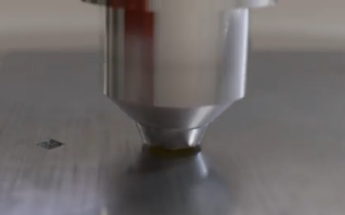
Hardness is determined by pressing a specific “indenter”, which is typically a diamond or hardened steel ball, into the surface of a material with a controlled amount of load. The resulting depth or area of the indentation is then measured to calculate the hardness value.
The reliability of a hardness testing machine depends heavily on the quality of the diamond and its specific crystal orientation. The tester indenter stable quality is warranted by high metallurgy technique and grinding diamond skill measuring. Thus, it ensures that every measurement is highly accurate and repeatable.
Common Hardness Scales
Here are the common hardness scales used depending on the type of material and the precision needed:
a. Vickers Hardness (HV)
It uses a square-based diamond pyramid indenter. It is highly versatile and used for both very soft and very hard materials, like thin coatings and industrial plating.
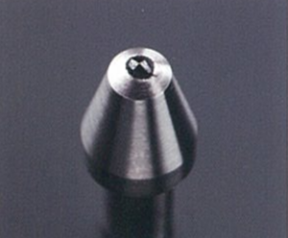
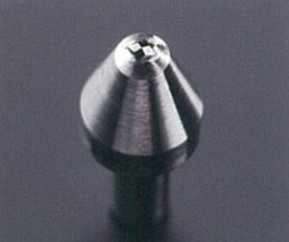
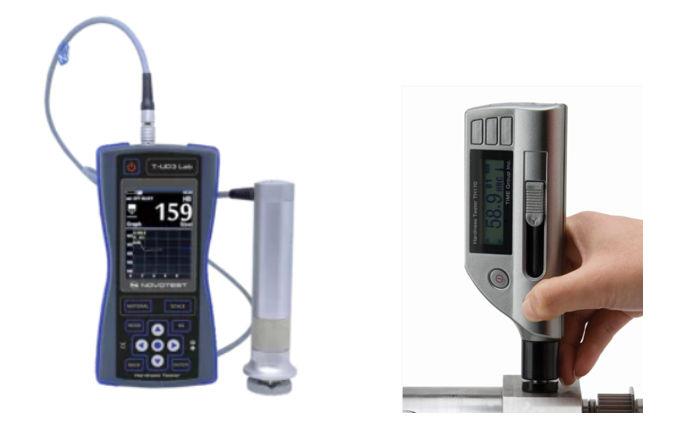
Using the hardness tester or device for HV, the diamond pyramid indenter is pressed into the material’s surface with a specific load, ranging from 1 gf to 100 kgf. The tester will calculate the size of the indentation and it will automatically reflect on the device’ screen. The Vickers Hardness (HV) number is calculated based on the applied load and the area of the indentation. The smaller the indentation, the harder the material. However, if the indention is larger, it means the material is soft. A value of 1000 HV, indicates a very high level of surface resistance. Which ensures that the component being tested can withstand extreme friction and abrasive wear, and can last longer.
Common materials and its HV value
| Mild Steel | approx. 140 – 280 HV |
| Tool Steel | approx. 600 HV |
| Hard Chrome | approx. 900 – 1100 HV |
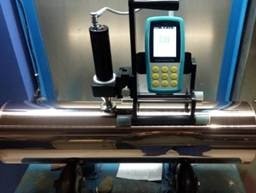
b. Rockwell Hardness (HRC/HRB)
The Rockwell method is one of the most common industrial testing standards. It measures the depth of penetration under a large load compared to the penetration made by a smaller preload.
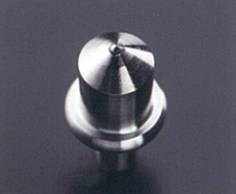
Steps for measuring using Rockwell Hardness tester:
First, a minor load is applied, which is an equivalent to a small force to break the surface of the material. The depth created will be the reference position. Next, the major load is applied and this load will create a deeper load in the material. Hold it for a specific or required time. The device measures the difference in depth between the preliminary and major load positions to provide a hardness value.
Rockwell testing has various scales designated by letters. The most commonly used are B and C.
- HRC (Rockwell C Scale) – It has a diamond cone indenter with a 120° top angle and applies a major load of 150 kgf. This scale works effectively for materials like hardened steel, titanium alloys, and pearlitic malleable iron. On the HRC scale, hardness range is generally from 20 to 70 HRC. A value of 1000 HV is equivalent to approximately 67-70 HRC.
- HRB (Rockwell B Scale) – It has a 1/16-inch (1.588 mm) steel ball indenter with a 100 kgf major load. This scale suits for softer materials such as, aluminium alloys, copper alloys, and malleable iron. Its hardness range is generally from 0 to 100 HRB.
c. Brinell Hardness (HBW)
The Brinell method utilises a heavy load and a spherical indenter made of hardened steel or tungsten carbide ball. It is pressed in the material with a specific load and time. After removing the load, the diameter of the indentation will be measured. Most of the testers today will automatically calculate the result. HBW is good to use for materials with coarse structures, like cast iron or forged steel.
d. Mohs Scale
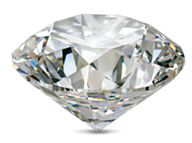
It is a qualitative scale of mineral hardness from 1 to 10 to determine the scratch resistance of various minerals through scratching other minerals. For example, the Talc mineral has a 1 rating because it can be easily scratched. However, the Diamond has a 10 rating which is considered as the hardest mineral because it can scratch all others. A hard chrome sits at about 8.5 to 9 on the Mohs scale, which is nearly as hard as a diamond.
Why Vickers Matters for Chrome Plating
The Vickers (HV) method is preferred for coating among various hardness testing, especially, for precision layers like hard chrome.
- Micro-Hardness Testing – The Vickers test uses light load to create small indents, making it perfect for measuring the hardness of very thin surface coatings.
- Accuracy and Precision – The diamond pyramid indenter produces a perfectly defined square indentation. This allows for highly reliable and repeatable results, even on the hardest industrial surfaces.
- Limitation of other hardness scales – The Rockwell and Brinell scale uses high loads and larger indenters that would affect through the chrome layer. If these were used on a very thin chrome coating, the device would measure the steel underneath the coating. This results in a misleadingly low hardness value.
The Real-World Effects of 1000 HV in Mining & Transport
- A 1000 HV rating provides a very superior resistance to wear and tear for your mining and transport components. Its surface is protected from small particles like dust, sand, and fine gravel.
- A 1000 HV significantly minimises the surface friction and lessens the scoring of the components.
- A 1000 HV makes the equipment last longer. A harder and more durable surface, extends the service life of the equipment. Hence, it reduces the frequency of replacements and lowers the long-term maintenance costs of your mining and transport components.
Why Hard Chrome Achieves Extreme Hardness (Microstructure)
In hard chrome plating, extreme hardness is achieved through the electroplating process. The hardness of the plated surface is a result of its Crystalline Microstructure -the specific arrangement of chromium atoms within the solid metal. In this procedure, the current density, bath chemistry, and bath temperature are strictly controlled to force the chrome to deposit in a fine crystalline structure that can resist indentation and abrasive wear effectively.

SJD Engineering’s Hardness Testing & Quality Control
Hard chrome plated components must undergo rigorous quality inspections and thorough hardness testing. Without verified data, a 1000 HV rating is merely a claim. At SJD Engineering, we utilises calibrated Vickers testers to confirm the surface hardness. Furthermore, all hardness measurements are properly documented and available to our clients, to ensure the quality of the plated finish. SJD Engineering guarantees that we will rework the coating until the required hardness is achieved.